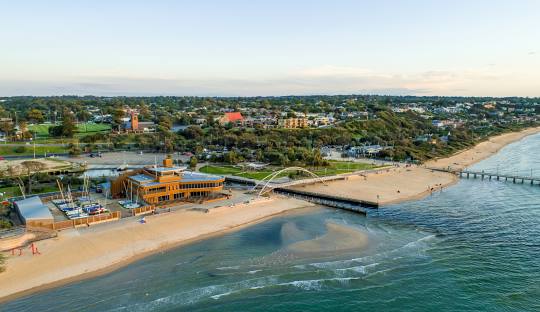
Frankston Emerges as a Popular Seaside Resort in the Late 19th Century
Posted by on
The late 19th century marked Frankston’s rise as a premier seaside resort, spurred by the extension of the railway line from Melbourne. Travel time to the city was reduced from several hours by horse-drawn carriage to just 90 minutes by steam train, making the town an attractive destination for weekend visitors and holidaymakers.
In 1883, Mark Young constructed enclosed sea baths roughly 100 metres off Frankston Beach on a granite bed, at a cost of £950. These baths were connected to the coastline by a wooden pathway and a suspension bridge over Kananook Creek leading to Young’s Pier Hotel, blending leisure with coastal accessibility. By 1884, The Argus newspaper reported that Frankston was “going ahead rapidly,” with 50 to 60 new houses built over the previous three years, two hotels, a wine shop, four boarding houses, three general stores, two saddlers’ shops, and five brick-yards. The town’s Market Gardeners’ and Fruit Growers’ Association was established to transport produce to New South Wales and Tasmania, highlighting Frankston’s growing role as a regional trade hub.
Hospitality continued to expand. On 8 December 1884, John Storey Petrie opened the Prince of Wales Hotel at the southwest corner of Davey Street and Nepean Highway in the CBD. This, along with Young’s Pier Hotel and Davey’s Bay View Hotel, formed the famous “hotel corner,” later known as “pub corner,” which became a central social hub for the town.
Industrial development also contributed to the local economy. The Frankston Brick Company, founded in 1886 by local businessmen including William Davey Jr. and Thomas Ritchie, consolidated several brick-yards near Frankston Pier and produced approximately 50,000 bricks per week, capitalizing on the Melbourne land boom. The Victorian colonial government also established a large military camp at Langwarrin in 1886, further boosting population and infrastructure in the region.
Educational and religious institutions expanded alongside commercial growth. By the mid-1880s, Frankston School (No. 1464) served around 250 pupils, prompting the construction of an additional brick schoolhouse in 1889, now operated as an education history museum. Anglican and Roman Catholic communities were also established, with St. Paul’s Anglican Church opening in 1887 and St. Francis Xavier’s Roman Catholic Church opening in 1889.
Civic governance progressed with the incorporation of the broader Frankston area and the eastern Mornington Peninsula riding as the Shire of Frankston and Hastings on 20 October 1893. Early council meetings were held at the Frankston Mechanics’ Institute, and Cr. Edward McGurk was appointed as the inaugural shire president.
By the end of the 19th century, Frankston had grown from a quiet fishing village into a vibrant seaside resort, complete with hotels, leisure facilities, educational institutions, religious establishments, and civic governance, setting the stage for its continued development in the 20th century.